Showing posts with label Mythology. Show all posts

Saturday, February 11, 2017

Devlok with Devdutt Pattanaik - Devdutt Pattanaik


Journey into the amazing world of Hindu mythology with Devdutt Pattanaik,
Why are most temples dedicated to Vishnu, Shiva or the goddess, but not to Brahma or Indra?
How are an asura, rakshasa,yaksha and pishacha different from each other?
Why did the Pandavas find themselves in naraka rather than swarga? 

Over several months, EPIC Channel's ground-breaking show Devlok with Devdutt Pattanaik has enthralled countless viewers.
Here, finally, is the book based on the first series of the ever popular show, which will take you on a scintillating tour through the myriad stories, symbols and rituals that form the basis of Hindu culture. 
Prepare to be surprised and thrilled as Devdutt narrates magical tales about larger-than life figures gods, goddesses, demi-gods and demons who you thought you knew well but didn t. 
Learn about the intricacies of Hindu thought as he explains the origin and meaning of different creation myths, and throws light on why we believe in a cyclical not linear concept of time. 
This book is your perfect introduction to the endlessly fascinating world of Hindu mythology.
[Book Description Source: www.amazon.com ] 


Ratings
Goodreads Rating - 3.84 out of 5 (327 Ratings; 28 Reviews - As on February 11 2017)
My Rating 3.5 out of 5
My Comments: Full of interesting facts and interpretation about Hindu god, goddesses, rituals, customs and philosophy.


Buying Options 

Buy from Amazon.com  Buy from Amazon.in Buy the Kindle Version

Saturday, November 26, 2016

Balaji-Venkateshwara, Lord of Tirumala, Tirupati - Nanditha Krishna


The Temple of Balaji or Venkateshwara on Tirumala hill above the town of Tirupati in India has become a focal point of contemporary religion attracting crowds of all ages,faiths and nationalities.
However,not much is known about the God,except his ability to answer prayers and perform the most improbable miracles.
Not many people are aware that the sanctity of the God and the hill is over two thousand years old.
What makes the temple so popular,and what are the beliefs of the people,are the questions that this Book has tried to answer. 

This Book is a collection of the folk legends about Venkateshwara,the sacred Tirumala hill and it's many lakes and waterfalls,his miracles,and the beautiful rituals and festivals associated with him.
He is a manifestation of Vishnu the preserver,and his association with the other incarnations is well documented. 

There are rare photographs of the God,his gold and diamond jewellery,the various other bronzes and sculptures contained in the temple and the images of the festivals for which Tirumala has been famous from time immemorial.
The illustrations of the stories have been executed in the Tirupati style of drawing. 

This Book should be of equal interest to to the layman,the scholar and the devotee,and a valuable addition to every home and library.

[Book Description Source: www.amazon.com ] 


Ratings
Goodreads Rating - 4 out of 5 (1 Rating; 0 Reviews - As on November 26 2016)
My Rating 4 out of 5
My Comments: Very beautifully illustrated pictorial guide with lots of interesting information.


Buying Options 
Buy from Amazon.com  Buy from Amazon.in 

Friday, January 29, 2016

Scion of Ikshvaku - Amish


Ramachandra Series - Book 1
Ram Rajya. 
The Perfect Land. 
But perfection has a price. 
He paid that price. 
3400 BCE. INDIA 
Ayodhya is weakened by divisions. 
A terrible war has taken its toll. 
The damage runs deep. 
The demon King of Lanka, Raavan, does not impose his rule on the defeated. He, instead, imposes his trade. 
Money is sucked out of the empire. 
The Sapt Sindhu people descend into poverty, despondency and corruption.
They cry for a leader to lead them out of the morass. 
Little do they appreciate that the leader is among them. 
One whom they know. 
A tortured and ostracised prince. 
A prince they tried to break.
 A prince called Ram. 
He loves his country, even when his countrymen torment him.
He stands alone for the law. 
His band of brothers, his Sita, and he, against the darkness of chaos. 
Will Ram rise above the taint that others heap on him? 
Will his love for Sita sustain him through his struggle? 
Will he defeat the demon Lord Raavan who destroyed his childhood? 
Will he fulfil the destiny of the Vishnu? 
Begin an epic journey with Amish's latest: The Ram Chandra Series.
[Book Description Source: www.amazon.com ] 

Ratings
Goodreads Rating - 3.6 out of 5 (7342 Ratings, 936 Reviews)
My Rating 3 out of 5.  

Buying Options 
Buy from Amazon.com  Buy from Amazon.in  Buy Kindle Version
(Anybody can read Kindle books—even without a Kindle device—with the FREE Kindle app for smartphones and tablets.)

Wednesday, June 3, 2015

Myths and Traditions in India - Prabhakar Patil

A Fusion of the Past and the Present
Far from being mere fairy tales or bed-time stories,myths found in every culture and civilization often have their roots in real-life characters and events,preserved through oral tradition over millennia. 
The cornucopia of Indian mythology and folklore, enshrined as it is in the four Vedas, Upanishads and Puranas, and the two greatest eternal epics of the Ramayana, and the Mahabharata, is probably the richest in the world. 
In the process of retelling many of these timeless classics, the author brings out their contents skillfully, establishing the fusion of past and present.

 [Book Description Source: www.goodreads.com]

Goodreads Rating - 2 out of 5 (1 Rating, 0 Review)

My Rating 2 out of 5

Buying Options 
 Buy from Amazon.com  Buy from Amazon.in

Friday, September 19, 2014

Jaya by Devdutt Pattanaik


An Illustrated Retelling of the Mahabharata
High above the sky stands Swarga, paradise, abode of the gods. 
Still above is Vaikuntha, heaven, abode of God.
The doorkeepers of Vaikuntha are the twins, Jaya and Yijaya, both whose names mean 'victory'.
One keeps you in Swarga; the other raises you into Vaikuntha.
In Vaikuntha there is bliss forever, in Swarga there is please for only as long as you deserve. 
What is the difference between Jaya and Vijaya? 
Solve this puzzle and you will solve the mystery of the Mahabharata.

In this enthralling retelling of India's greatest epic, the Mahabharata originally known as Jaya, Devdutt Pattanaik seamlessly weaves into a single narrative plots from the Sanskirt classic as well as its many folk and regional varians, including the Pandavani of Chattisgarth, Gondhal of Maharastra, Terukkuttu of Tamil Nade and Yakshagana of Karnataka.

Richly illustrated with over 250 line drawings by the author, the 108 chapters abound with little-known details such as the names of the hundred Kauravas, the worship of Draupadi as a goddess in Tamil Nadu, the stories of Astika, Madhavi, Jaimini, Aravan and Barbareek, the Mahabharata version of the Shakuntalam and the Ramayana, and the dating of the war based on astronomical data.
With clarity and simplicity, the tales in this elegant volume reveal the eternal relevance of the Mahabharata, the complex and disturbing meditation on the human condition that has shaped Indian thought for over 3000 years.
[Source: Inside cover of the book]

My Comments:
This is the third book of Devdutt Pattanaik which I read, the other ones  being 7 Secrets of Vishnu and 7 Secrets of Shiva.
Doing full justice to Mahabaharata, one of the longest epics ever written (more than 100,000 verses), in 300 odd pages is a challenge to any author. 
Therefore  the author has focused on the lesser known incidents in this epic. He has also provided his own interpretation after every chapter which are quite interesting to read.
The line drawings and the layout of the pages of this book are simple yet very elegant. This proves you don't really need colors to make things attractive.
All these aspects make this book a highly readable and enjoyable one,as evidenced in more than 300  reviews by the readers in Goodreads site.

Links:

Goodreads Rating - 4.19 out of 5 ( 35 Ratings)


Buy the Kindle book version.
(Anybody can read Kindle books—even without a Kindle device—with the FREE Kindle app for smartphones and tablets.)

Sunday, December 23, 2012

7 Secrets of Shiva


Author:     Devdutt Pattanaik
Published: 2011
Publisher: Westland Ltd.
Paperback: 234 pages


I was really impressed with the author's book 7 Secrets of Vishnu which I  read last year. I have even written a summary of it in this  blog.
So I ordered for this book when one of my Flipkart coupons was about to expire.
This book intends to clarify for the readers the implicit patterns in the stories, symbols and rituals of Lord Shiva.
There are seven chapters in this book.
The first chapter,Lingeshwara's Secret - Imagination makes us human, explains the meaning of the Shiva-linga going beyond its conventional interpretation as a phallic symbol. 
The second chapter ,Bhairava's Secret- From fear comes all corruption, focuses on Shiva's violent disdain for territorial behavior amongst humans.
The third and fourth chapters - Shankara's Secret - Without empathy there is no evolution and Bholenath's Secret - Culture is a human delusion - deal with how the Goddess Shakti, Shiva's consort gets him to compassionately engage with the world.
The next two chapters - Ganesha's Secret - Food alone does not satisfy hunger and Murugan's Secret - Face fear to outgrow it -  revolves around these two son's of Shiva who, through whom he connects with the world.
The final chapter, Nataraja's Secret - Destruction is deconstruction, presents Shiva as the wise teacher who expresses wisdom through dance.


All the legends , rituals and symbols are very well interpreted, though I am not sure whether it is author's own interpretation or whether it is based on his research.
The writing style is more coherent and simpler as compared to the author's other book 7 Secrets of Vishnu.
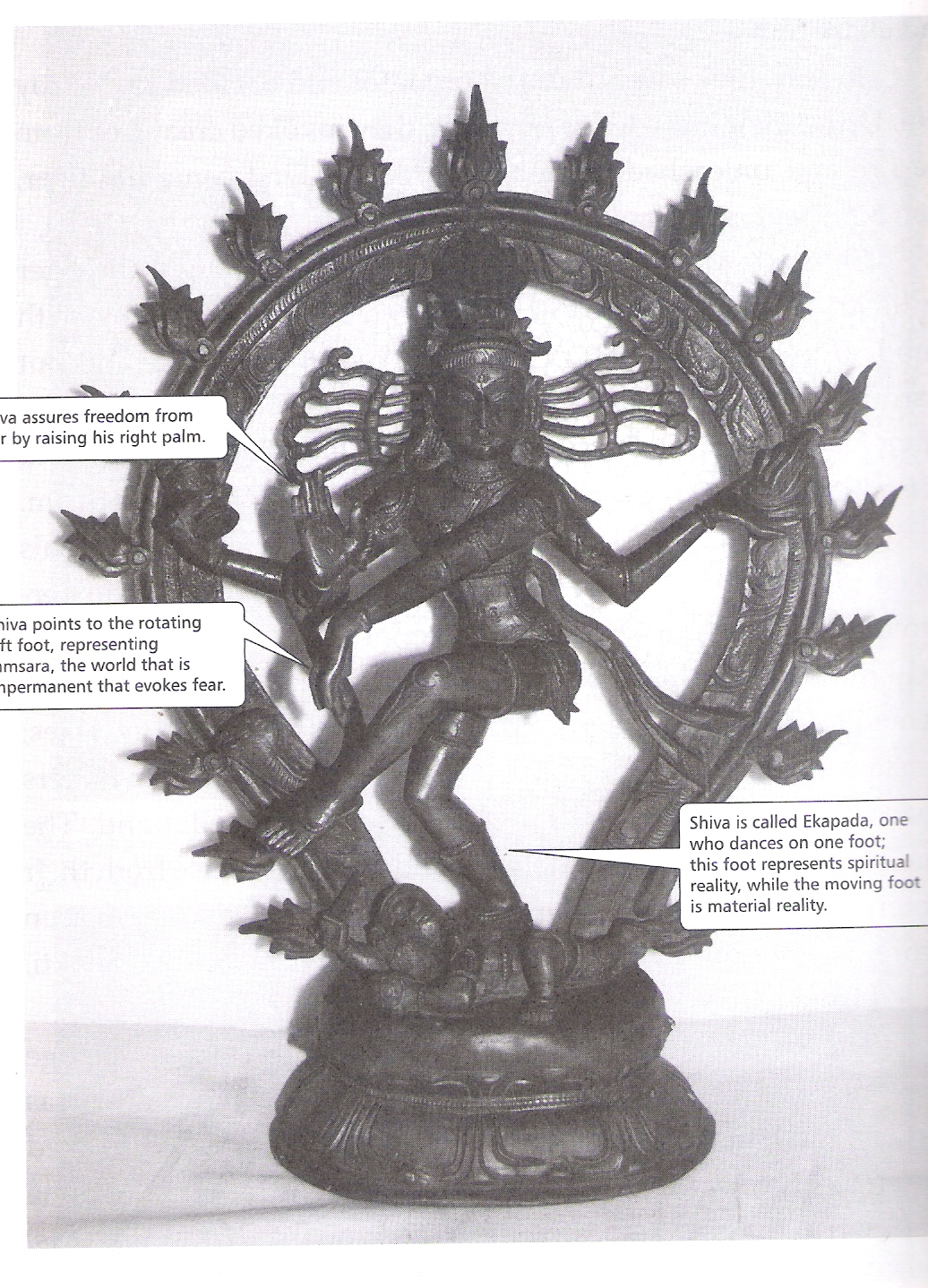
The book has an attractively designed cover and profusely illustrated. Every alternate page has an illustration of a classic painting  or a calendar art or a temple sculpture. The illustrations are well supported by explanations in call-out bubbles which point to the exact part of the illustration being explained. See below a sample of such illustrations.
A few suggestions for the author and the publisher to be taken care of in the next edition:
  • A glossary for non-English terms used in this book.
  • An index to easily locate the interesting pieces of information.
  • A consolidated list of all the illustrations along with their sources. 
  • A hardcover version of this book with glossy illustrations in color will make this an excellent coffee table book.
I would recommend it to anyone who is interested in religious mythology, spirituality or philosophy. At just Rs. 250/- this book is a real bargain. 

Links:
Sample illustrations from this book: 


[Please feel free to leave your comments below or bookmark/share this summary]


Friday, February 3, 2012

The Secret of the Nagas

Author:         Amish
Published:   2011
Publisher:    Westland Ltd.
Paperback: 414 pages
 

The saga of  Shiva continues in this book which forms the second part of Shiva trilogy., the first being  - The Immortals of Meluha.
Shiva after leading Meluhans to their victory over the Chandravanshis of Swadweep finds that even Chandravanshis like Meluhans revere him and look upon him as a savior. So the real enemies of Meluhans seem to be the Nagas, a mysterious tribe which has carried out guerrilla warfare on Meluhans.
This book is mainly Shiva's hunt for the Nagas with the help of a combined army of Meluhans and Chandravanshis.

The plot is  fast-moving and very imaginative .The characters Kartik, Parasuram, Ganesha and Kali are introduced. And there is a yet another surprise ending to this book (though I had intuitively guessed it).
But unlike the first book, the characters in this book are not well developed, though there was enough opportunity to do so. As a result the book comes down to a level of a slightly above average thriller. 
Nevertheless I found this book a better read than the "Immortals of Meluha" mainly because it has more interesting twists and turns. Look forward to the concluding part of the trilogy which is likely to be released later this year.


Links:
  • The Shiva Trilogy website - Do watch the high quality and professionally produced video trailers of the book available in this website.
  • Read an excerpt from this book.

[Please feel free to leave your comments below or bookmark/share this summary]

Friday, November 25, 2011

The Immortals of Meluha

Author:         Amish
Published:   2010
Publisher:    Westland Ltd.
Paperback: 466 pages
 

This is a  story about the  transformation of a  Tibetan tribal leader to a savior of the country of Meluha.
This Tibetan is none another than whom many Hindus worship as Lord Shiva and Meluha is " what modern Indians mistakenly call the Indus Valley Civilization".
This is an  imaginative rendering of the saga of Lord Shiva.
A modern Shiva Puranam !
This book is the first book in the Shiva Trilogy , the second being "The Secret of the Nagas" and the third "The Oath of the Vayuputras (yet to be released)".
The book begins with Shiva being convinced by Nandi (a Meluhan) to emigrate from Mansarovar , Mt. Kailash to Meluha along with Gunas , the members of his tribe. It concludes with Shiva leading Meluhans to a resounding victory over their enemies the Chandravanshis of Swadweep. However Shiva is rather pained by this victory and almost goes into depression. Why ? Read the book to find out!
The plot is quite interesting, fast-moving and has a surprising twist in the end.  It has author's own logical and quite credible interpretations of - how Shiva got his blue throat (thereby the name "Neelkanth"); how his weapon the trident (Trishul) was conceived; his third-eye; the symbol "Aum"; reincarnations of Vishnu etc. Though this book is packed with events, yet author has managed to portray Shiva's character, his dilemmas and  his sense of humor pretty well. 
The underlying message of this book as mentioned by Amish, the author in the introduction is "... all of us can rise to be better people.....there exists a potential god in every human being. All we have to do is to listen to ourselves." 
However from a literary perspective I would rate Ashok Banker's book "The Prince of Ayodhya", which belongs to the same genre, a notch higher (See my review of this book). But Banker's book is more voluminous and rather too descriptive which may be a bit too much for many readers (not for me though ! I liked it).  And this is where "The Immortals of Meluha" has an edge. It is more appealing to a wider audience and has become No.1 National Bestseller.
Though it did not meet my expectations 100 % (may be I had too high an expectation based on what I heard and read about it), I still enjoyed reading it and look forward to reading its sequels.

Links:
[Please feel free to leave your comments below or bookmark/share this summary]


Tuesday, November 8, 2011

7 Secrets of Vishnu


Author:     Devdutt Pattanaik
Published: 2011
Publisher: Westland Ltd.
Paperback: 232 pages

I received this book from Blogadda under their book review program.
I belong to the Iyengar community which worships Vishnu as their main deity. Therefore I am generally familiar with most of the legends and rituals built around Vishnu. However I was always curious to know the hidden meaning and significance behind them and hence this book sounded interesting and I offered to review it. 

There are seven chapters in this book, each dealing with one secret of Vishnu. These seven chapters also correspond to seven of the several avatars (reincarnations) of Vishnu viz.; Mohini, Matsya, Kurma, Trivikrama, Ram, Krishna and Kalki.  These avatars are chosen to explain various underlying and hidden metaphysical and philosophical themes :
  1. Mohini's Secret - Spiritual growth need not exclude material growth.. 
  2. Matsya's Secret - Difference between man and animal - only humans can empathize, and exploit.
  3. Kurma's Secret - Wealth eludes the insecure.
  4. Trivikrama's Secret - Ignorance breeds insecurity and ignorance.
  5. Ram's Secret - Outgrow the beast to discover the divine.
  6. Krishna's Secret - Know the thoughts behind actions.
  7. Kalki's Secret - The wisdom of letting go of things with a faith in its renewal.
 The title of the book is a misnomer for it reveals much more than seven secrets of Vishnu . It also slips in the secrets of  Shiva, Brahma, Saraswati, Lakshmi and many more gods, goddesses, asuras and rakshsas as well as a bonus within confines of the above chapters !
All the legends , rituals and symbols are very well interpreted, though I am not sure whether it is author's own interpretation or whether it is based on the research he had conducted.The writing style could have been simplified a bit more. It is slightly abstruse and somewhat disjointed and lacks a spontaneous flow. This may cause some difficulty to readers not exposed to Hindu philosophical concepts, though for me it is not a major issue.
The book has an attractively designed cover and an impressive layout of pages.It is profusely illustrated. Every alternate page has an illustration of a classic painting (for e.g.Mysore painting, Kerala murals, Pahari miniature, Mughal paintings, Patta paintings etc.) or a calendar art or a temple sculpture. The illustrations are well supported by explanations in call-out bubbles which point to the exact part of the illustration being explained. See below a sample of such illustrations.
A few suggestions for the author and the publisher to be taken care of in the next edition:
  1. A glossary for non-English terms used in this book.
  2. An index to easily locate the interesting pieces of information.
  3. A consolidated list of all the illustrations along with their sources.
  4. A hardcover version of this book with glossy illustrations in color will make this an excellent coffee table book.
Overall I am really impressed with this book and would recommend it to anyone who is interested in religious mythology, spirituality or philosophy. At just Rs. 250/- this book is a real bargain. 
I was luckier since I got to read it free. However as a part of the deal ,  I had to try hard and take time out to write a 500 word review within the 7 days deadline given by BlogAdda. But it was worth it.

Visit the Author's website for interesting articles on mythology.

Sample illustrations from this book:


This review is a part of the Book Reviews Program at BlogAdda.com. Participate now to get free books!
[Please feel free to leave your comments below or bookmark/share this summary]


Wednesday, October 12, 2011

Prince of Ayodhya - Book One of the Ramayana

Author:        Ashok K. Banker
Published:  2005
Publisher:   Penguin Books India
Paperback: 534 pages


The story of  Ramayana takes me back to my childhood days when I  used to repeatedly hear it from my grandfather who was a great storyteller. His vivid narration had a deep impact on me and I myself at the age of 5 or 6 started telling the story of Rama to whoever cared to listen and appreciate!
Nowadays I prefer Mahabharata to Ramayana since I think the characters in the former are more realistically portrayed.  However  this book - Prince of Ayodhya : Book One of the Ramayana -  written by Ashok Banker has rekindled my interest in Ramayana enough to look forward to reading its sequels too.
I had always thought of Ashok Banker as a pulp fiction author and had not cared to read any of his books.  I could not have got to reading even this, had I found the book - The Immortals of Meluha by Amish Tripathi  - I was looking for in the library.  Tripathi's book has received good reviews for its contemporary treatment of Lord Shiva's story. But it so happened that  "The Immortals of Meluha "was not available so I picked up this book instead since it seemed to be of the same genre i.e. modern interpretation of a mythological figure.
The book begins with the Author's note where he tells us how Ramayana came to be written by Valmiki and subsequently by many others who followed him, each adding their own interpretations and embellishments so that  " there are as many Ramayanas as there are people who know the tale, or claim to know it. And no two versions are exactly alike". Then Banker proceeds to say what was his motivation to add yet another version of this great epic to the literature. 
This volume deals with princes Rama and Lakshmana  being sent with Sage Vishwamitra to protect the yagna (sacrificial rites) he is performing from getting disturbed by  the Asuras. The princes successfully accomplish this mission by killing the demons Taraka and Subhahu. 
Now this is a bare outline of this volume. Banker through his creative imagination and interpretations has added sub-plots and incidents not found in any of the previous versions of Ramayana and has described them very vividly. This has bloated the size of the book to 500 odd pages based on this outline. Yet  not in any point of time while  reading it I was bored. This itself speaks of the author's story telling prowess.
Visit the Wikipedia entry about this book where plot summary and a section on how it differs from the original Valmiki Ramayana is provided.

Recommend this book for a light and entertaining reading. But definitely won't  recommend it to highly religious and pious people who look upon  Rama as a God. 

[Please feel free to leave your comments below or bookmark/share this summary]